
Macro- and micro-hemodynamic influences in the freediving Everesting world record.
DOI:10.36210/BerMedJ/epub0012025
DOI:
https://doi.org/10.36210/bermedj.v7i1.51Abstract
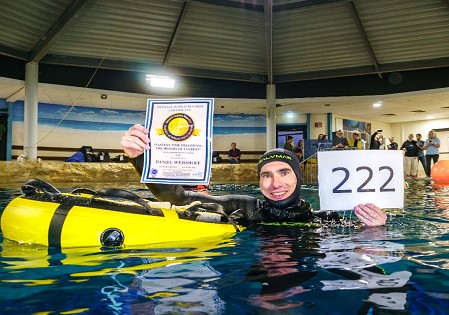
Everesting is a new endurance sport in which athletes cover a cumulative altitude of 8848 meters over a defined but freely selectable distance on a mountain. The total distance has never before been covered in apnea diving. In a diving tower with a water depth of 20 meters, the freediver performed a total of 222 apnea dives in 12:57:09 hours. The transcutaneous oxygen partial pressure (TINA 4, Radiometer, Copenhagen), the pulse wave transient time (PWTT) for calculating cardiac output and standard monitoring with ECG, RR, SpO2 (Life Scope, BSM 6501, Nihon Kohden, Japan) as well as microcirculation (O2C, LEA Medizintechnik Giessen, Germany) and the determination of core body temperature using infrared thermometry in the ear canal were examined. Before the competition, the transcutaneous oxygen pressure was 83 mmHg, which increased during the first 50 dives and remained almost constant during the rest of the competition. (Mean=129.9±20.39 standard deviation). With a coefficient of determination of R² = 0.3255, the values follow a power equation with the formula y = 104.24x0.1367. The perfusion index decreases significantly over the course of the study period compared to the initial value (p<0.01, t-test) and does not change significantly during the competition (p>0.05, t-test). The pulse wave transient time and the cardiac index showed no significant differences from the baseline measurement during the study period (p>0.05, t-test). According to Dalton's gas law, the partial pressures only change within the total pressure. Due to the increase in the partial pressure of water vapor by 23 mmHg and the exhalation of carbon dioxide of 35 mmHg, there is no nitrogen saturation of the tissue during the apnea dives in freediving Everesting. The decrease in the perfusion index, the decrease in blood flow in the tissue and the decrease in oxygen saturation in the tissue suggest hydrostatically induced peripheral vasocompression while the hemoglobin content remains constant. The resulting thoracic volume shift showed no significant effects in the measurements of the cardiac index of macrohaemodynamics and the measurements of microhaemodynamics.
Downloads
Published
How to Cite
Issue
Section
License
Copyright (c) 2024 Olaf Schedler; Daniel Weißhoff

This work is licensed under a Creative Commons Attribution-NonCommercial-NoDerivatives 4.0 International License.


